Axillary Vein
By : Ali JalalDefinition
It is the deep vein of upper limb.
It has three parts correspond to the three parts of the axillary artery.
It has three parts correspond to the three parts of the axillary artery.
Origin and Termination
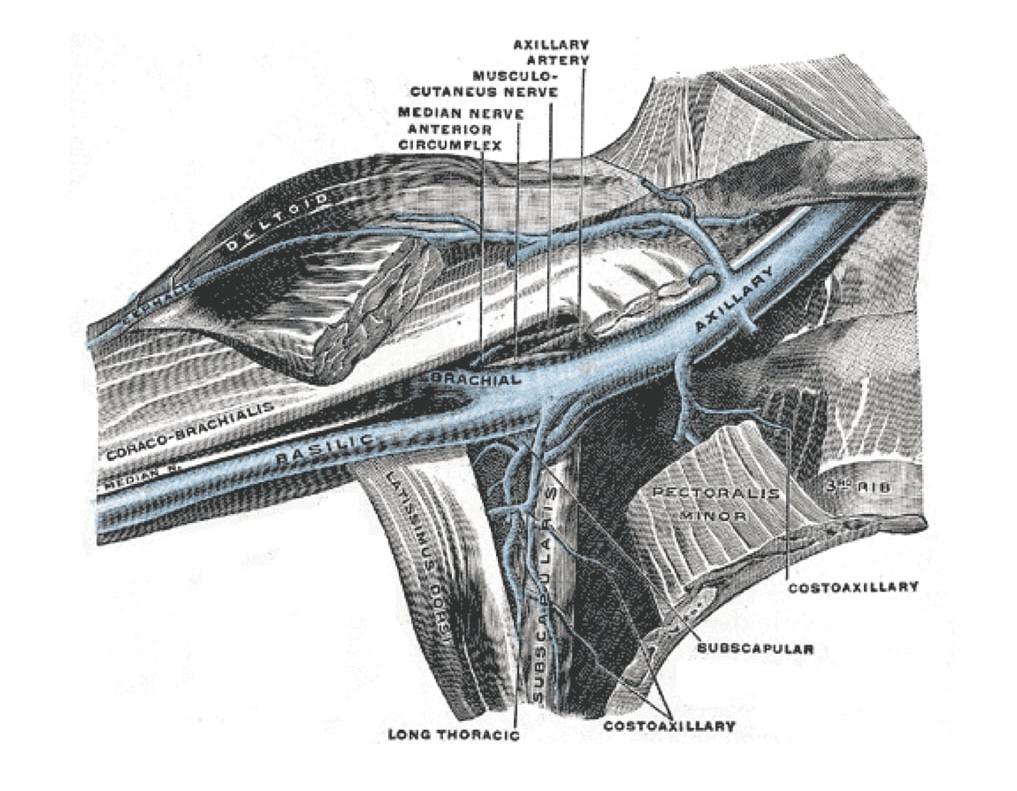
Axillary vein begins at the
lower border of teres major muscle(beneath it)by union
of the basilic vein and the venae
comitantes of brachial artery.
Itpasses upward to the medial side of the axillary artery, and ends at the lateral border of the first rib and continues as subclavian vein .
lower border of teres major muscle(beneath it)by union
of the basilic vein and the venae
comitantes of brachial artery.
Itpasses upward to the medial side of the axillary artery, and ends at the lateral border of the first rib and continues as subclavian vein .

Venous Drainage
Axillary vein receives deoxygenated blood from:
1-arm
2-axilla
3-thorax(superolateral chest wall)
It receives also thoracoepigastric vein which is formed by anastomoses of superficial veins from inguinal region with tributaries of the axillary vein .
Axillary vein drains to the subclavian vein .
1-arm
2-axilla
3-thorax(superolateral chest wall)
It receives also thoracoepigastric vein which is formed by anastomoses of superficial veins from inguinal region with tributaries of the axillary vein .
Axillary vein drains to the subclavian vein .
Relations
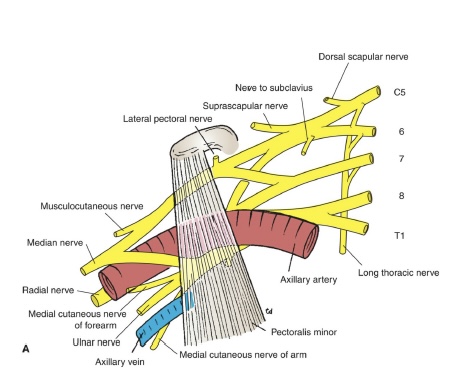
It lies in the medial side of the axillary artery, separated from :
1)3rd part by the ulnar n. and the medial cutaneous n. of forearm.
2)2nd part by the medial cord of the brachial plexus.
3)1st part( it is closely related).
1)3rd part by the ulnar n. and the medial cutaneous n. of forearm.
2)2nd part by the medial cord of the brachial plexus.
3)1st part( it is closely related).
Tributaries of axillary vein
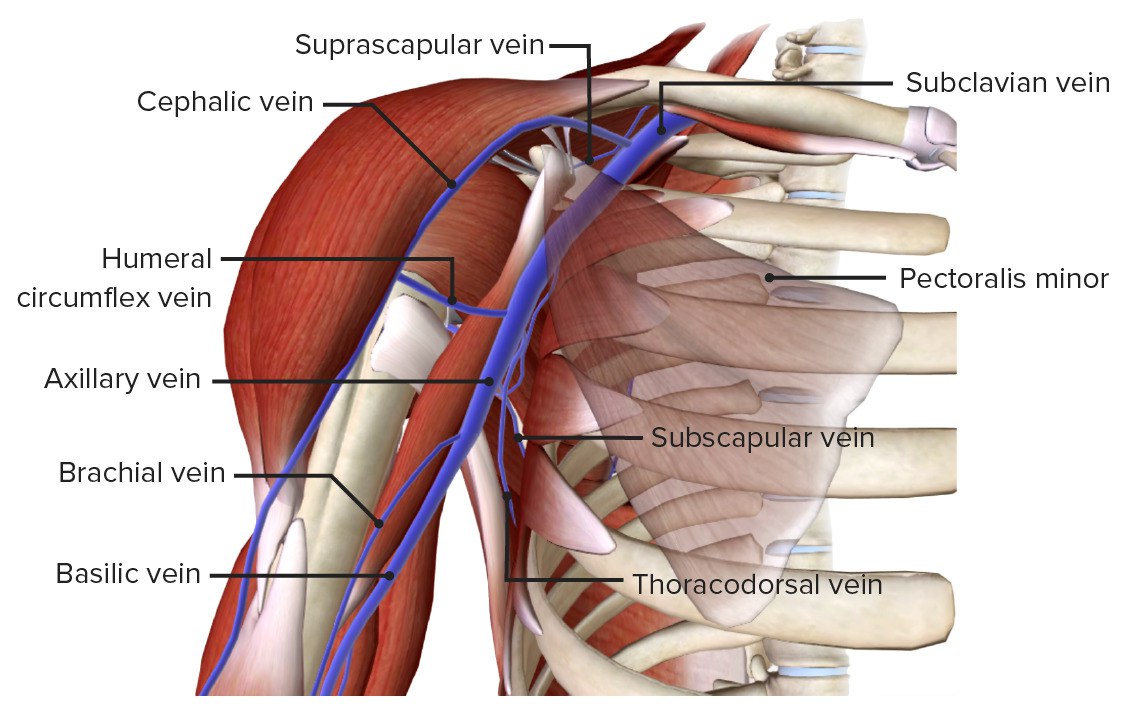
1)Thoraco-acromial veins,are:
A)Pectoral vein
B)Clavicular vein
C)Deltoid vein
D)Acromial vein
2)Lateral thoracic vein
3)Superior thoracic vein
4)Subscapular vein
5)Circumflex humeral vein
6)Cephalic vein
Note : the tributaries correspond to the branches of the axillary artery except for the cephalic vein.
A)Pectoral vein
B)Clavicular vein
C)Deltoid vein
D)Acromial vein
2)Lateral thoracic vein
3)Superior thoracic vein
4)Subscapular vein
5)Circumflex humeral vein
6)Cephalic vein
Note : the tributaries correspond to the branches of the axillary artery except for the cephalic vein.
Clinical Note
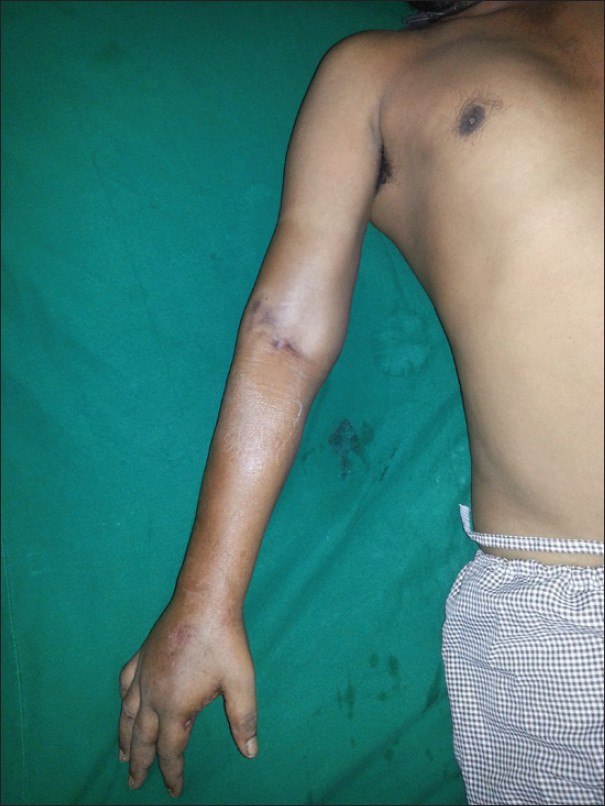
Axillary Vein Thrombosis
(deep vein thrombosis or DVT)
Blood clotting of the axillary vein is relatively rare in the general population, though it occurs more often in competitive athletes.
Repeated strain, injury, or other factors which leads to swelling, blue color, heaviness, and pain in the arm.
If untreated, this condition can lead to pulmonary embolism , stroke, heart failure, and venous insufficiency, among other dangerous conditions.
Blood-thinning medications, physical therapy, as well as surgeries, resolve this condition.
Treatment
DVT is often treated with a combination of several medications and therapies as anticoagulants, anticoagulant drugs, often called blood thinners, are used to prevent the abnormal blood clotting.
Although these drugs cannot dissolve blood clots that have already formed, they are an important and potentially life-saving medication for people with DVT or pulmonary embolism (PE).
Blood thinners work by interrupting the clotting process.
In people with DVT, they prevent existing clots from getting bigger and prevent future clots from forming.
When DVT is present, immediate treatment with anticoagulation therapy (blood thinners) will help prevent further blood clotting in the leg veins while reducing the chances of developing a pulmonary embolism.
(deep vein thrombosis or DVT)
Blood clotting of the axillary vein is relatively rare in the general population, though it occurs more often in competitive athletes.
Repeated strain, injury, or other factors which leads to swelling, blue color, heaviness, and pain in the arm.
If untreated, this condition can lead to pulmonary embolism
Note
blood clot in the lungBlood-thinning medications, physical therapy, as well as surgeries, resolve this condition.
Treatment
DVT is often treated with a combination of several medications and therapies as anticoagulants, anticoagulant drugs, often called blood thinners, are used to prevent the abnormal blood clotting.
Although these drugs cannot dissolve blood clots that have already formed, they are an important and potentially life-saving medication for people with DVT or pulmonary embolism (PE).
Blood thinners work by interrupting the clotting process.
In people with DVT, they prevent existing clots from getting bigger and prevent future clots from forming.
When DVT is present, immediate treatment with anticoagulation therapy (blood thinners) will help prevent further blood clotting in the leg veins while reducing the chances of developing a pulmonary embolism.
References
1. Keith L. Moore , Arthur F. Dalley A. M. R. Agur; Moore clinically oriented anatomy 7th edition;pp.99,691,715,718-719
2. The axillary vein and its tributaries are not in the mirror image of the axillary artery and its branches;HyeYeon Lee,JongHo Bang,SooJung Kim,HeeJun Yang;.; National Library of Medicine; https://www.ncbi.nlm.nih.gov/pmc/articles/PMC6328140/
3. Axillary vein;Gordana Sendić,MD;Kenhub;https://www.kenhub.com/en/library/anatomy/axillary-vein
4. The Anatomy of the Axillary Vein;Mark Gurarie; Verywellhealth; https://www.verywellhealth.com/axillary-vein-anatomy-5097415
2. The axillary vein and its tributaries are not in the mirror image of the axillary artery and its branches;HyeYeon Lee,JongHo Bang,SooJung Kim,HeeJun Yang;.; National Library of Medicine; https://www.ncbi.nlm.nih.gov/pmc/articles/PMC6328140/
3. Axillary vein;Gordana Sendić,MD;Kenhub;https://www.kenhub.com/en/library/anatomy/axillary-vein
4. The Anatomy of the Axillary Vein;Mark Gurarie; Verywellhealth; https://www.verywellhealth.com/axillary-vein-anatomy-5097415