
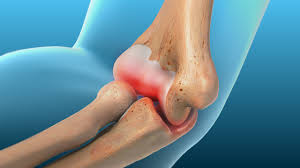
Common Elbow Injuries
By : Yaser MohammedIntroduction
Most elbow injuries usually occur in the soft tissues founds around it, injuries related to the muscles, tendons, ligaments, and nerves which provide its stability and motion.
the most common injuries to the elbow joint are:
the most common injuries to the elbow joint are:
Distal Biceps Strain or Tear
Distal Biceps Strain or Tear: The biceps muscle has a direct action on the flexion of the elbow and also play role in the supination of forearm and shoulder movement.
A strain or tear of the distal biceps tendon occur normally due to forceful elbow extension. partial tear of the distal biceps tendon may be treated conservatively with physical therapy.
While a complete tear of the distal biceps tendon requires surgery. [see fig 1]
A strain or tear of the distal biceps tendon occur normally due to forceful elbow extension. partial tear of the distal biceps tendon may be treated conservatively with physical therapy.
While a complete tear of the distal biceps tendon requires surgery. [see fig 1]

Biceps Insertion in the elbow
Triceps Strain or Tear
Triceps Strain or Tear: The triceps has a direct action on the extension of the elbow. the triceps has three heads attached to the humerus with various origins, these three heads come together to form the triceps tendon, which attaches to the olecranon (the pointy part of the elbow).
A minor strain of the triceps tendon can be solved with rest.
while the triceps strain or tear is rare, the injury normally occurs due to overuse or a sudden change in activity (such as a new weight lifting program). elbow bending forcefully against the resistance is some sports as football also can cause triceps tearing.[see fig 2]
A minor strain of the triceps tendon can be solved with rest.
while the triceps strain or tear is rare, the injury normally occurs due to overuse or a sudden change in activity (such as a new weight lifting program). elbow bending forcefully against the resistance is some sports as football also can cause triceps tearing.[see fig 2]

Triceps Insertion in the elbow
Lateral Epicondylitis (Tennis Elbow)
Lateral Epicondylitis (Tennis Elbow): It’s an inflammation in the wrist and finger tendons (tendonitis) which is attached to the outside of the elbow. Due to repetitive action and the over use of muscles of the forearm. It affects the attachment site of the wrist extensor muscle group, which runs on the back of the forearm, into the outside of your elbow. Acute injury to this tendon could cause a possible disruption or tear, activities like typing, hammering or playing tennis could cause tendon thickening and inflammation. symptoms can be worsen through doing activities or by playing sports.
Treatment is mostly conservative, including physical therapy interventions.
Treatment is mostly conservative, including physical therapy interventions.

Lateral Epicondylitis
Medial Epicondylitis (golfer’s elbow)
Medial Epicondylitis (golfer’s elbow): It's an inflammation of the forearm and fingers’ tendons at the inside of the elbow. occur due to forearm rotation overuse, or gripping and forceful wrist flexion.
Golfer’s elbow symptoms include pain and tenderness at the medial elbow where the forearm and finger flexors attach.
Treatment options for golfer’s elbow include:
• Rest
• Activity modification
• Stretching/strengthening exercises
• Soft tissue mobilization techniques
• Pain reducing modalities (e.g: ice massage)
Golfer’s elbow symptoms include pain and tenderness at the medial elbow where the forearm and finger flexors attach.
Treatment options for golfer’s elbow include:
• Rest
• Activity modification
• Stretching/strengthening exercises
• Soft tissue mobilization techniques
• Pain reducing modalities (e.g: ice massage)

Comparing Medial Epicondylitis (golfer’s elbow) and Lateral Epicondylitis (Tennis Elbow):
Ligament Sprain or Tear
Ligament Sprain or Tear: On the elbow’s inner and outer sides, thicker ligaments (collateral ligaments) hold the elbow joint together and prevent dislocations. The ligament on the inside of the elbow is the ulnar collateral ligament (UCL).and must withstand extreme stresses as it stabilizes the elbow during overhand throwing.
The most commonly affected ligament in the elbow is the UCL. Injuries of the UCL can range from minor sprains and inflammation to a complete tear of the ligament. Athletes will have pain on the inside of the elbow and frequently notice decreased throwing velocity. This injury is most commonly seen in overhand throwers, such as baseball/softball players and pitchers.
Conservative treatment includes rest and physical therapy.
The most commonly affected ligament in the elbow is the UCL. Injuries of the UCL can range from minor sprains and inflammation to a complete tear of the ligament. Athletes will have pain on the inside of the elbow and frequently notice decreased throwing velocity. This injury is most commonly seen in overhand throwers, such as baseball/softball players and pitchers.
Conservative treatment includes rest and physical therapy.
Throwing injuries
Throwing injuries: Throwing causes very high stress on the elbow which can cause serious overuse injuries through repetition of this action, occur especially in some sports such as baseball.
Throwing injuries can affect multiple structures in the elbow; Muscles, ligaments, and nerves can all be affected in the thrower’s elbow:
1) Flexor Tendonitis
2) Ulnar Collateral Ligament Sprain/Tear
3) Ulnar Neuritis
4) Ulnar Extension Overload
5) Stress Fracture
6) Nerve Compression
Throwing injuries can affect multiple structures in the elbow; Muscles, ligaments, and nerves can all be affected in the thrower’s elbow:
1) Flexor Tendonitis
2) Ulnar Collateral Ligament Sprain/Tear
3) Ulnar Neuritis
4) Ulnar Extension Overload
5) Stress Fracture
6) Nerve Compression

Throwing Elbow injuries