
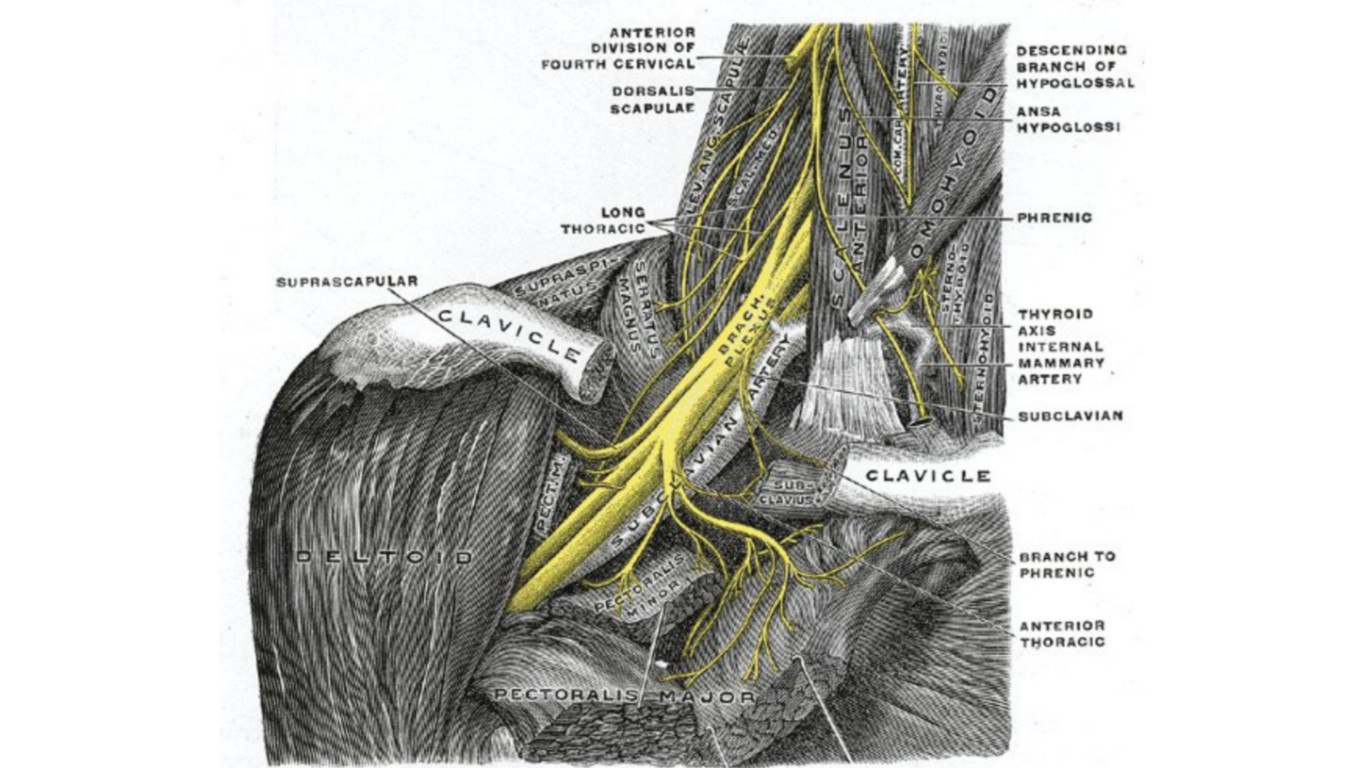
Long thoracic nerve
By : Omair AlkatanOverview
The long thoracic nerve, also called the external respiratory nerve of Bell or posterior thoracic nerve, originates from the upper portion of the superior trunk of the brachial plexus and normally receives contributions from cervical nerve roots C5, C6, and C7. A distinct feature of the long thoracic nerve is its superficial course along the entire length of the serratus anterior muscle it supplies. It is responsible for the innervation of the serratus anterior muscle; its course starts as
Path
1- the long thoracic nerve descends posteriorly to the roots of the brachial plexus.
2- anteriorly to the scalenus posterior muscle.
3- courses along the chest wall in the mid-axillary line to lie on the superficial surface of the serratus anterior muscle.
4-The nerve further divides into smaller branches parallel to the main trunk before turning at right angles and providing innervation to the individual slips by entering via the superior aspect of the slips.
2- anteriorly to the scalenus posterior muscle.
3- courses along the chest wall in the mid-axillary line to lie on the superficial surface of the serratus anterior muscle.
4-The nerve further divides into smaller branches parallel to the main trunk before turning at right angles and providing innervation to the individual slips by entering via the superior aspect of the slips.
Clinical note
Due to its long, relatively superficial course, the long thoracic nerve can be damaged easily. When the long thoracic nerve is injured:
Visible scapular winging at rest (usually inferior border only), with overhead motions, or resisted wall push-ups/push-ups whereby the entire scapula demonstrates winging.
Pain around the base of the neck, deltoid, and scapula. This would be accounted for by spasms in the levator scapula and rhomboid muscles as they perform unopposed against the serratus anterior.
Restrictions of forward flexion and abduction of the shoulder (usually to less than 100 degrees). Patients may notice a lack of power in throwing moves. Nonetheless, it may be possible to still achieve full upward rotation due to the motion of the trapezius muscles.
Visible scapular winging at rest (usually inferior border only), with overhead motions, or resisted wall push-ups/push-ups whereby the entire scapula demonstrates winging.
Pain around the base of the neck, deltoid, and scapula. This would be accounted for by spasms in the levator scapula and rhomboid muscles as they perform unopposed against the serratus anterior.
Restrictions of forward flexion and abduction of the shoulder (usually to less than 100 degrees). Patients may notice a lack of power in throwing moves. Nonetheless, it may be possible to still achieve full upward rotation due to the motion of the trapezius muscles.
Damage to the nerve could happen by:
Traction of the nerve as it leaves the fascial sheath has been frequently mentioned as the most obvious source of damage following paralysis of the serratus anterior. This can result from overuse in athletes with regular overhead arm movements. This repetitive action extends and potentially shears the nerve.
Lateral flexion of the head away from the nerve also extends the nerve. When coupled with overhead arm movements that further stretch the nerve, which may suffer damaging repetitive traction and compression, this action may occur in overhead athletes and account for up to 35% of palsy cases.
Spasms of the middle scalene muscle may compress the nerve.
Compression can occur over the second rib as it changes angles. The bringing closer of the second rib and coracoid process when the scapula is completely retracted medially.
The inferior angle of the scapula represents another possible area of compression and traction on the nerve near the level of the eighth and ninth rib. In asynchronous scapula motion, the inferior angle of the scapula may be the source of damage to the nerve.
Four bursas, the subcoracoid, subscapular, accessory, and supracoracoid, could cause compression if inflamed.
Critical trauma to the nerve may occur from a clavicle or scapula fracture, a surgical operation, or an infection, such as tonsillitis or bronchitis. It may also happen following immunizations, carrying a heavy load, or sleeping in an awkward position.
Traction of the nerve as it leaves the fascial sheath has been frequently mentioned as the most obvious source of damage following paralysis of the serratus anterior. This can result from overuse in athletes with regular overhead arm movements. This repetitive action extends and potentially shears the nerve.
Lateral flexion of the head away from the nerve also extends the nerve. When coupled with overhead arm movements that further stretch the nerve, which may suffer damaging repetitive traction and compression, this action may occur in overhead athletes and account for up to 35% of palsy cases.
Spasms of the middle scalene muscle may compress the nerve.
Compression can occur over the second rib as it changes angles. The bringing closer of the second rib and coracoid process when the scapula is completely retracted medially.
The inferior angle of the scapula represents another possible area of compression and traction on the nerve near the level of the eighth and ninth rib. In asynchronous scapula motion, the inferior angle of the scapula may be the source of damage to the nerve.
Four bursas, the subcoracoid, subscapular, accessory, and supracoracoid, could cause compression if inflamed.
Critical trauma to the nerve may occur from a clavicle or scapula fracture, a surgical operation, or an infection, such as tonsillitis or bronchitis. It may also happen following immunizations, carrying a heavy load, or sleeping in an awkward position.
Conservative rehabilitation:
consists of the following phases(adapted from Watson and Schenkman 1995)(9):
1- Protection from further nerve trauma (during the complete denervation period):
a. Avoid overhead lifting and loaded motions.
b. Avoid extending the serratus anterior (avoid excessive retraction and downward rotation motions.
c. Maintain range of motion. This is best achieved by actively moving the arm while in a supine position so that the scapula is fixed and will not wing and cause further nerve traction.
d. Scapular taping and/or bracing to sit the scapula against the chest wall.
2- Isolated activation (when the nerve shows some recovery and the serratus anterior shows activity with voluntary contraction):
a. Gentle supine protraction drills focusing on the serratus anterior and not the pectoralis minor. b. Stretch pectoralis minor, rhomboids, and levator scapulae to prevent
3- adaptive shortening in these muscles (due to unopposed serratus anterior activity).
Functional retraining:
As the nerve regains innervation to the serratus anterior, introduce direct functional serratus anterior exercises
1- Protection from further nerve trauma (during the complete denervation period):
a. Avoid overhead lifting and loaded motions.
b. Avoid extending the serratus anterior (avoid excessive retraction and downward rotation motions.
c. Maintain range of motion. This is best achieved by actively moving the arm while in a supine position so that the scapula is fixed and will not wing and cause further nerve traction.
d. Scapular taping and/or bracing to sit the scapula against the chest wall.
2- Isolated activation (when the nerve shows some recovery and the serratus anterior shows activity with voluntary contraction):
a. Gentle supine protraction drills focusing on the serratus anterior and not the pectoralis minor. b. Stretch pectoralis minor, rhomboids, and levator scapulae to prevent
3- adaptive shortening in these muscles (due to unopposed serratus anterior activity).
Functional retraining:
As the nerve regains innervation to the serratus anterior, introduce direct functional serratus anterior exercises
References:
1. Wiater JM, Flatow EL. Long thoracic nerve injury. Clin Orthop Relat Res. 1999 Nov;(368):17-27. [PubMed]
2. Martin RM, Fish DE. Scapular winging: anatomical review, diagnosis, and treatments. Curr Rev Musculoskelet Med. 2008 Mar;1(1):1-11. [PMC free article] [PubMed]
3. Bertelli JA, Ghizoni MF. Long thoracic nerve: anatomy and functional assessment. J Bone Joint Surg Am. 2005 May;87(5):993-8. [PubMed]
4. Kauppila LI. The long thoracic nerve: Possible mechanisms of injury based on autopsy study. J Shoulder Elbow Surg. 1993 Sep;2(5):244-8. [PubMed]
5. Shilal P, Sarda RK, Chhetri K, Lama P, Tamang BK. Aberrant Dual Origin of the Dorsal Scapular Nerve and Its Communication with Long Thoracic Nerve: An Unusual Variation of the Brachial Plexus. J Clin Diagn Res. 2015 Jun;9(6): AD01-2. [PMC free article] [PubMed]
6. Laulan J, Lascar T, Saint-Cast Y, Chammas M, Le Nen D. Isolated paralysis of the serratus anterior muscle successfully treated by surgical release of the distal portion of the long thoracic nerve. Chir Main. 2011 Apr;30(2):90-6. [PubMed]
7. Vetter M, Charran O, Yilmaz E, Edwards B, Muhleman MA, Oskouian RJ, Tubbs RS, Loukas M. Winged Scapula: A Comprehensive Review of Surgical Treatment. Cureus. 2017 Dec 07;9(12):e1923. [PMC free article] [PubMed]
8. Goslin KL, Krivickas LS. Proximal neuropathies of the upper extremity. Neurol Clin. 1999 Aug;17(3):525-48, vii. [PubMed]
9. Phys Ther 1995;75:194–202.
2. Martin RM, Fish DE. Scapular winging: anatomical review, diagnosis, and treatments. Curr Rev Musculoskelet Med. 2008 Mar;1(1):1-11. [PMC free article] [PubMed]
3. Bertelli JA, Ghizoni MF. Long thoracic nerve: anatomy and functional assessment. J Bone Joint Surg Am. 2005 May;87(5):993-8. [PubMed]
4. Kauppila LI. The long thoracic nerve: Possible mechanisms of injury based on autopsy study. J Shoulder Elbow Surg. 1993 Sep;2(5):244-8. [PubMed]
5. Shilal P, Sarda RK, Chhetri K, Lama P, Tamang BK. Aberrant Dual Origin of the Dorsal Scapular Nerve and Its Communication with Long Thoracic Nerve: An Unusual Variation of the Brachial Plexus. J Clin Diagn Res. 2015 Jun;9(6): AD01-2. [PMC free article] [PubMed]
6. Laulan J, Lascar T, Saint-Cast Y, Chammas M, Le Nen D. Isolated paralysis of the serratus anterior muscle successfully treated by surgical release of the distal portion of the long thoracic nerve. Chir Main. 2011 Apr;30(2):90-6. [PubMed]
7. Vetter M, Charran O, Yilmaz E, Edwards B, Muhleman MA, Oskouian RJ, Tubbs RS, Loukas M. Winged Scapula: A Comprehensive Review of Surgical Treatment. Cureus. 2017 Dec 07;9(12):e1923. [PMC free article] [PubMed]
8. Goslin KL, Krivickas LS. Proximal neuropathies of the upper extremity. Neurol Clin. 1999 Aug;17(3):525-48, vii. [PubMed]
9. Phys Ther 1995;75:194–202.