
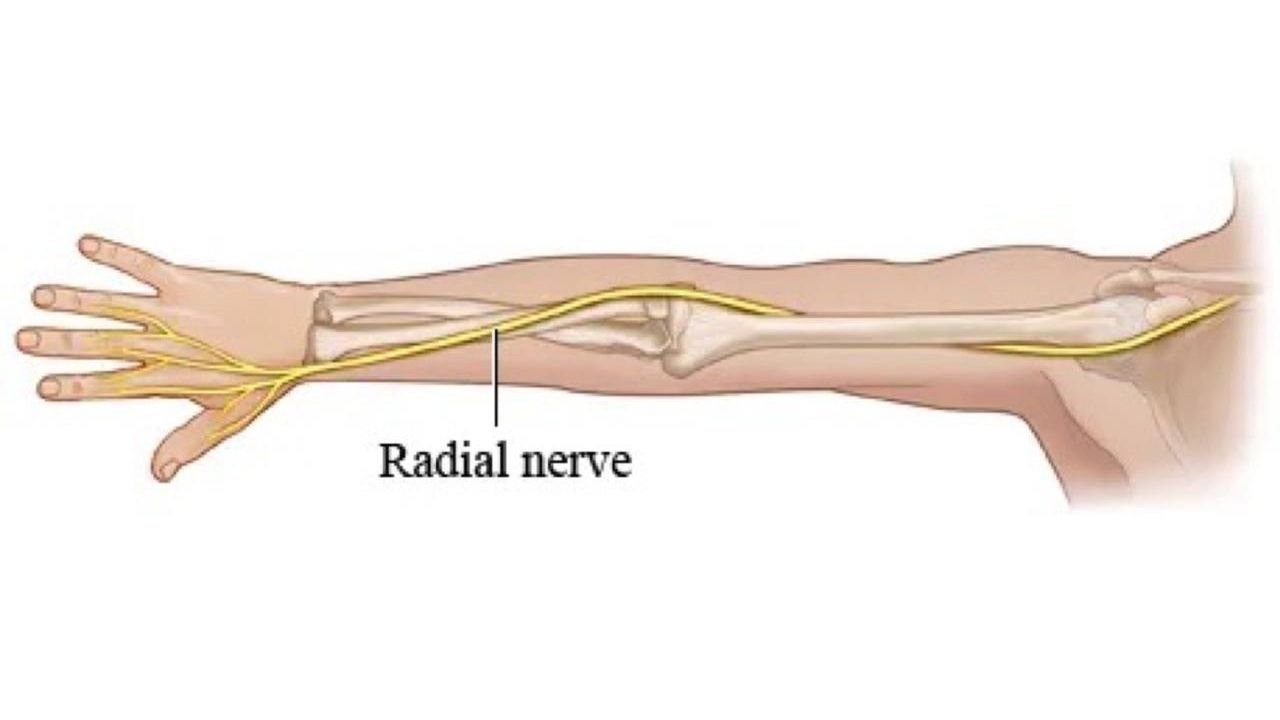
Radial nerve
By : Omar Al-abdrabaOrigin and course
The radial nerve (C5-T1) is the largest terminal branch of the posterior cord of the
brachial plexus and the largest nerve in the upper limb.
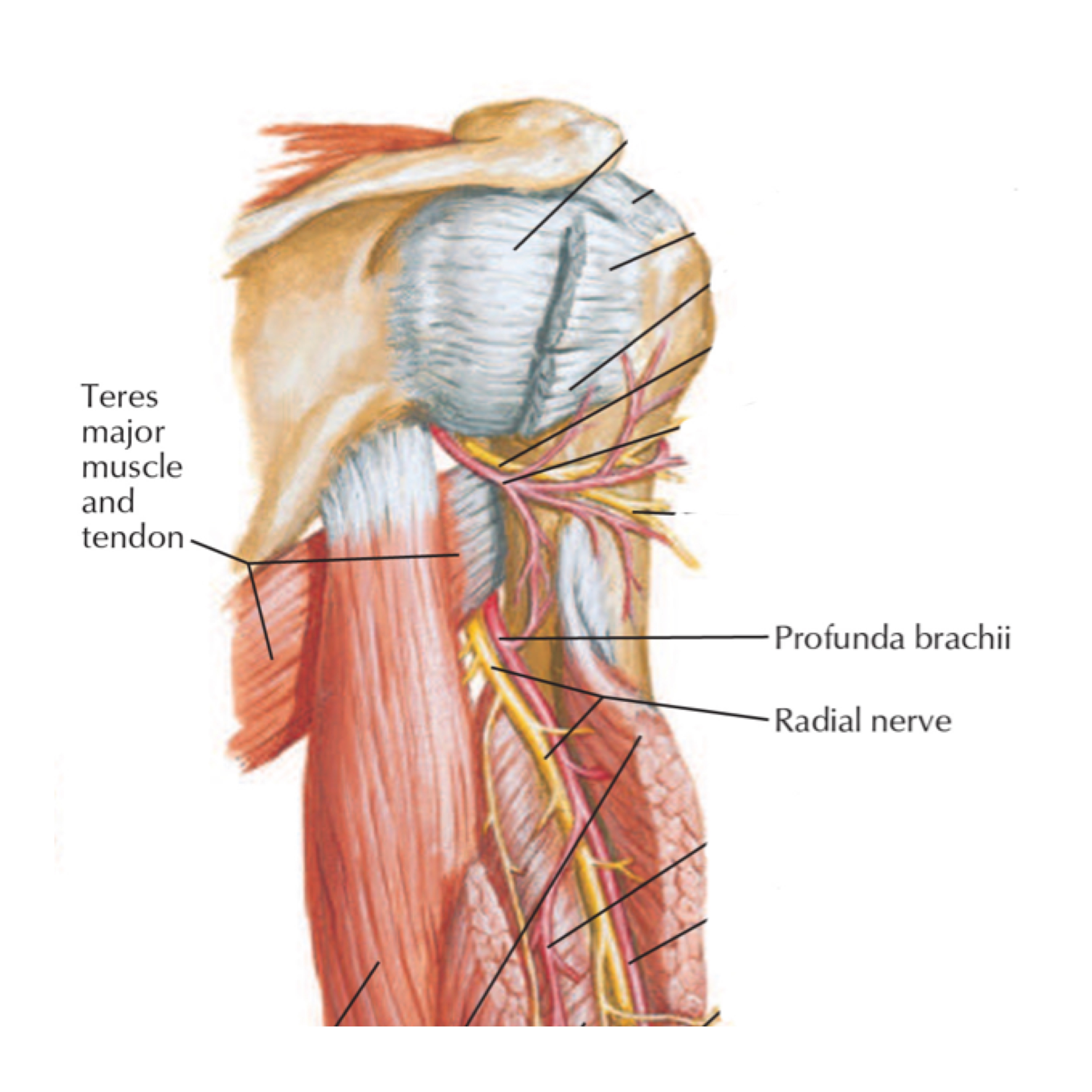
It passes out of the axilla and into the posterior compartment of the arm crossing the inferior margin of the teres major by passing through the Lower triangular space (also called “lateral triangular space", "triangular interval” or “triceps hiatus”) accompanied with profunda brachii artery.
brachial plexus and the largest nerve in the upper limb.
It passes out of the axilla and into the posterior compartment of the arm crossing the inferior margin of the teres major by passing through the Lower triangular space (also called “lateral triangular space", "triangular interval” or “triceps hiatus”) accompanied with profunda brachii artery.

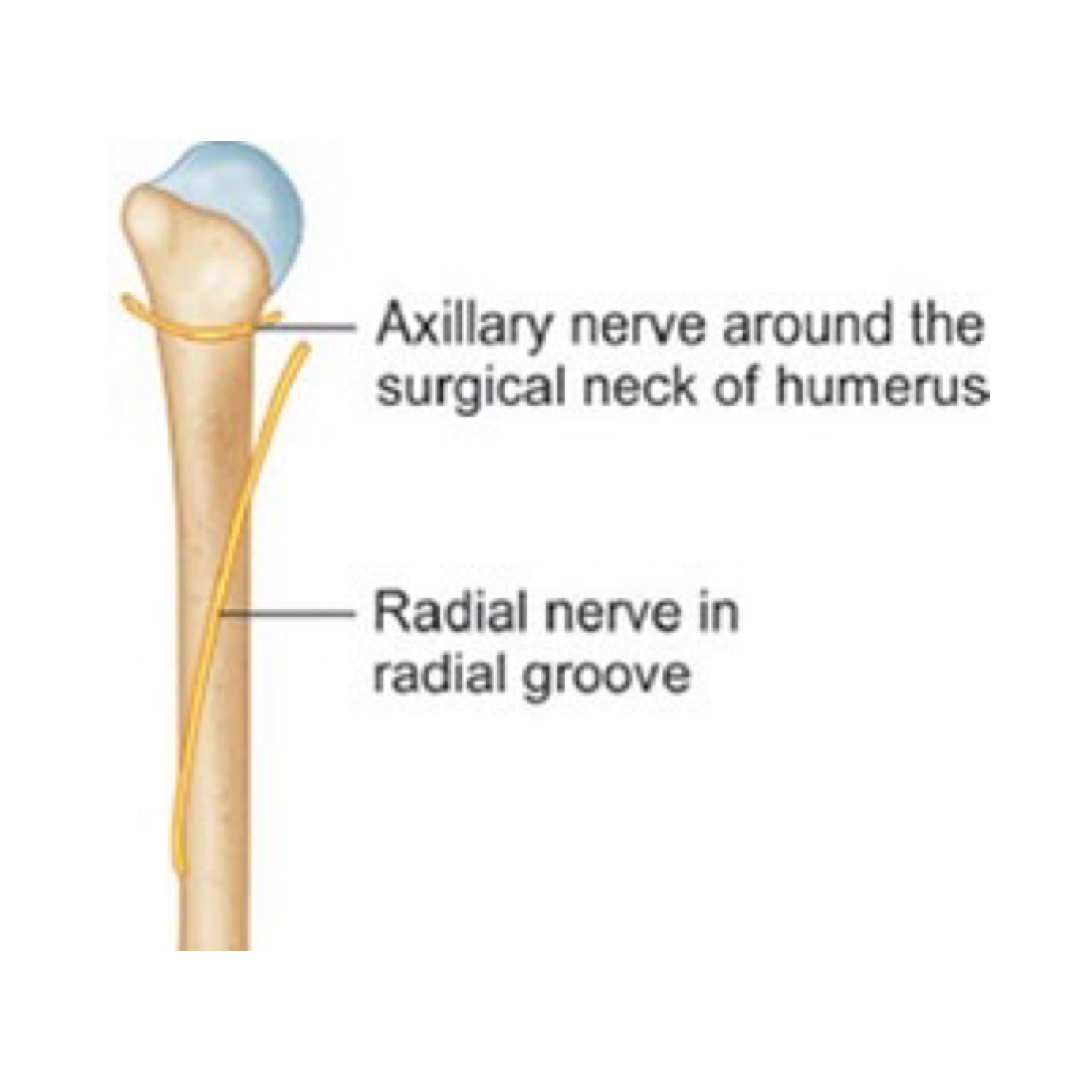
It then descends diagonally down along the posterior surface of the humerus in the radial groove (also called “musculospiral groove”, “radial sulcus”, or “spiral groove”).

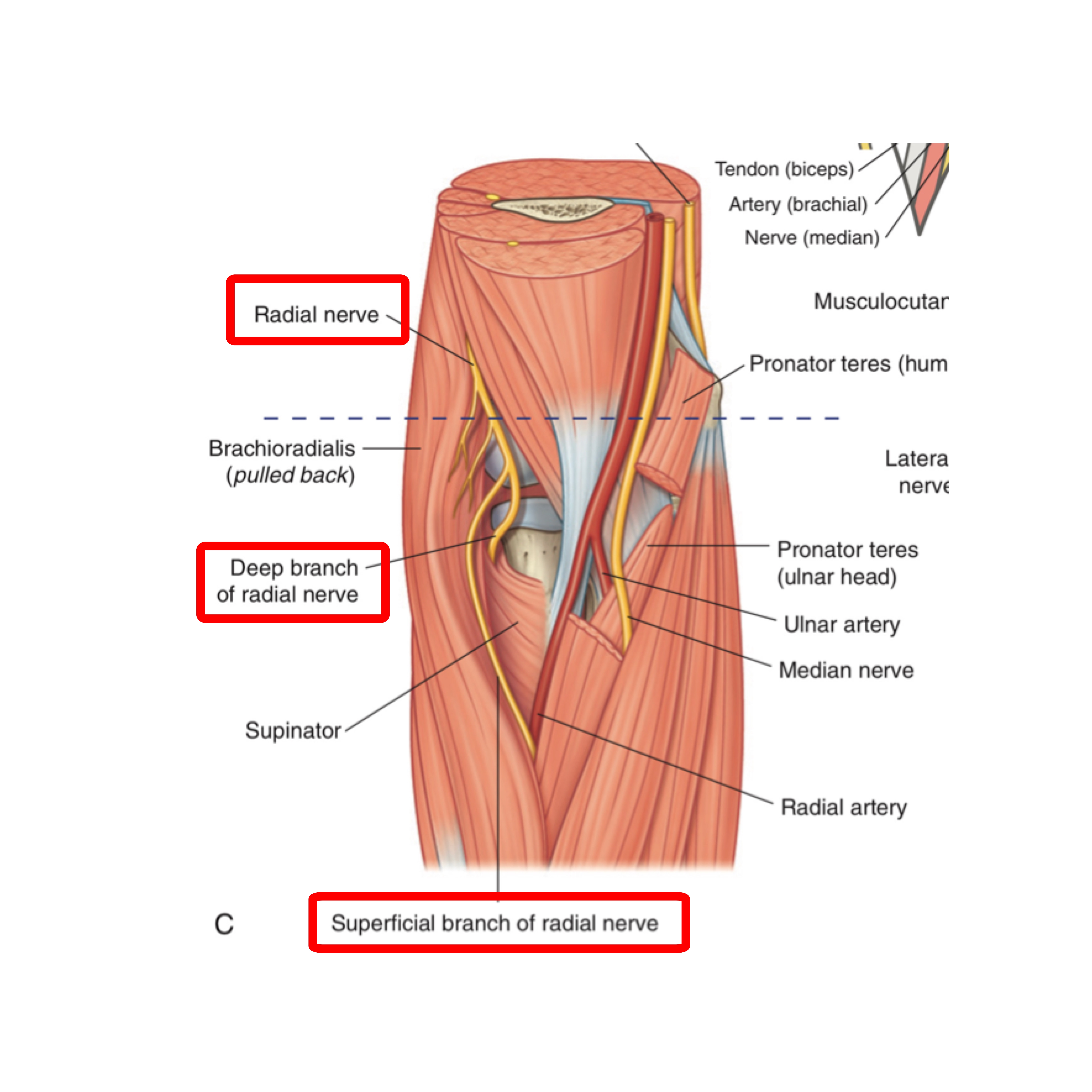
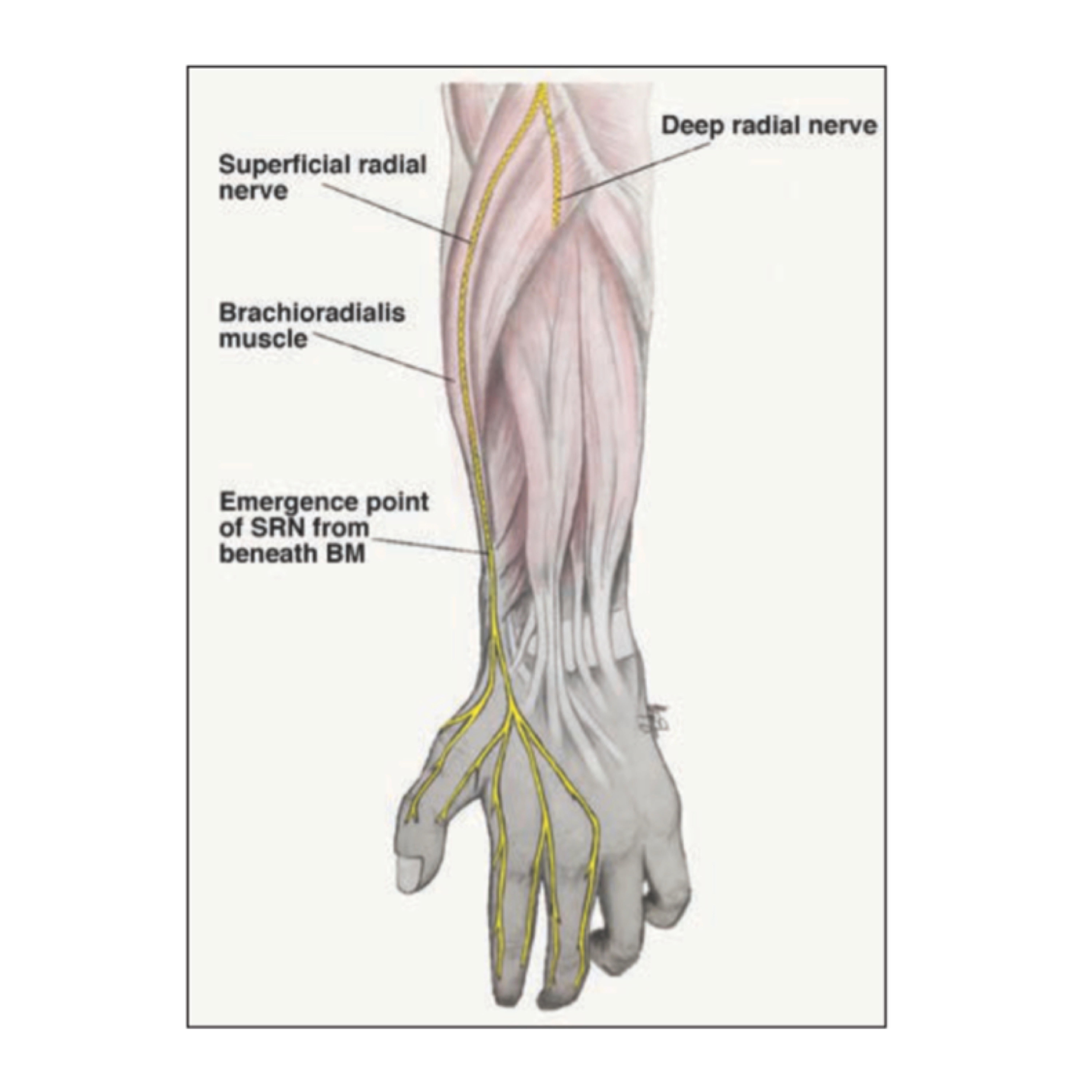
Then it passes anteriorly through the lateral intermuscular septum and enters the anterior compartment where it lies between the brachialis muscle and a muscle of the posterior compartment of the forearm then it enters the forearm anterior to the lateral epicondyle of the humerus just deep to the brachioradialis muscle through the cubital fossa and then terminates in the posterior compartment of forearm by dividing into two terminal branches one is superficial (sensory) and the other is deep (motor) nerve (also called” posterior interosseous ”).
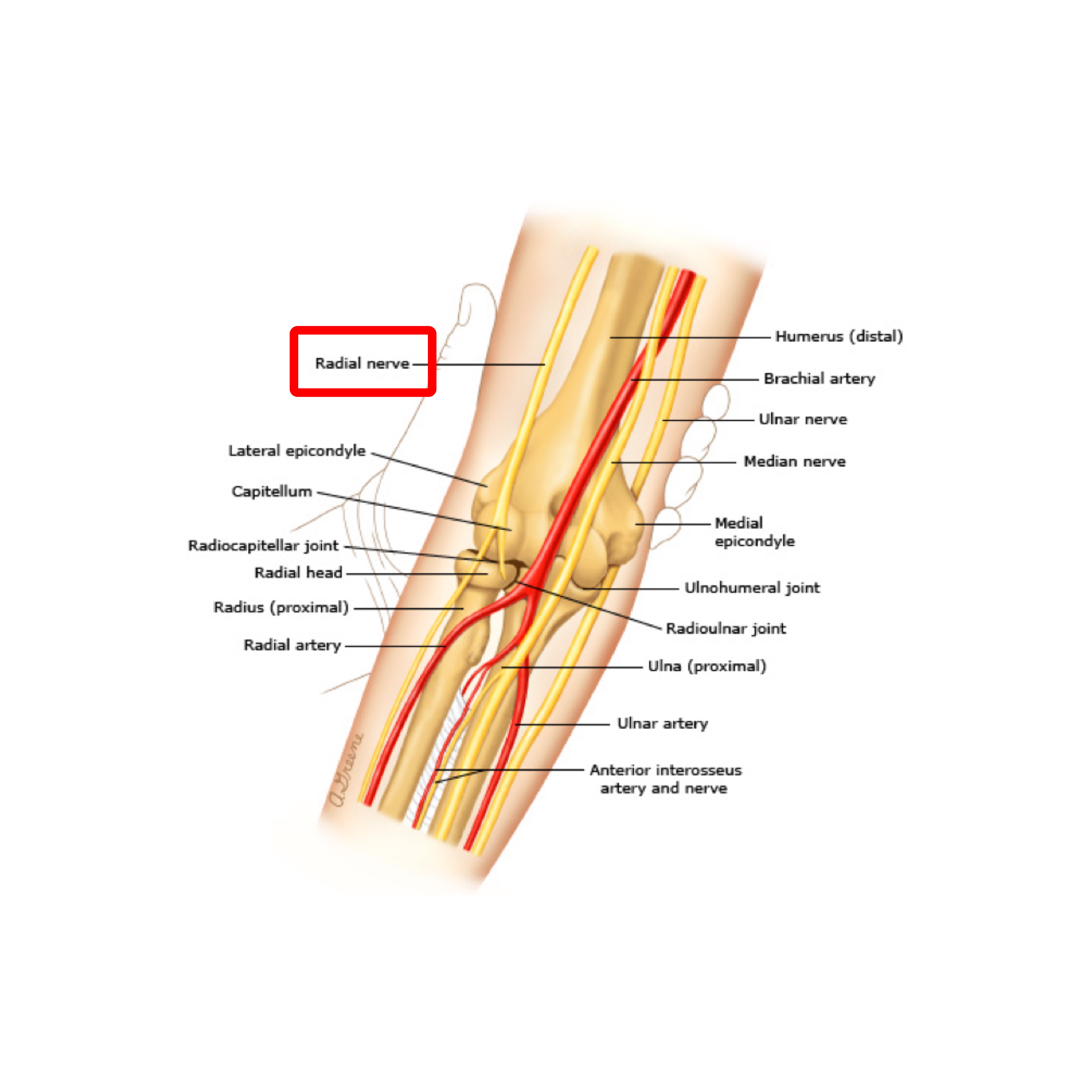
Branches and innervations
In the arm region the radial nerve gives five terminal nerve branches three motor nerves Wich goes to the muscles and two sensory nerves Wich goes to the skin.
The motor nerve branches go to:
1) triceps brachii muscle.
2)anconeus muscle.
3)brachioradialis muscle.
While the sensory nerves are:
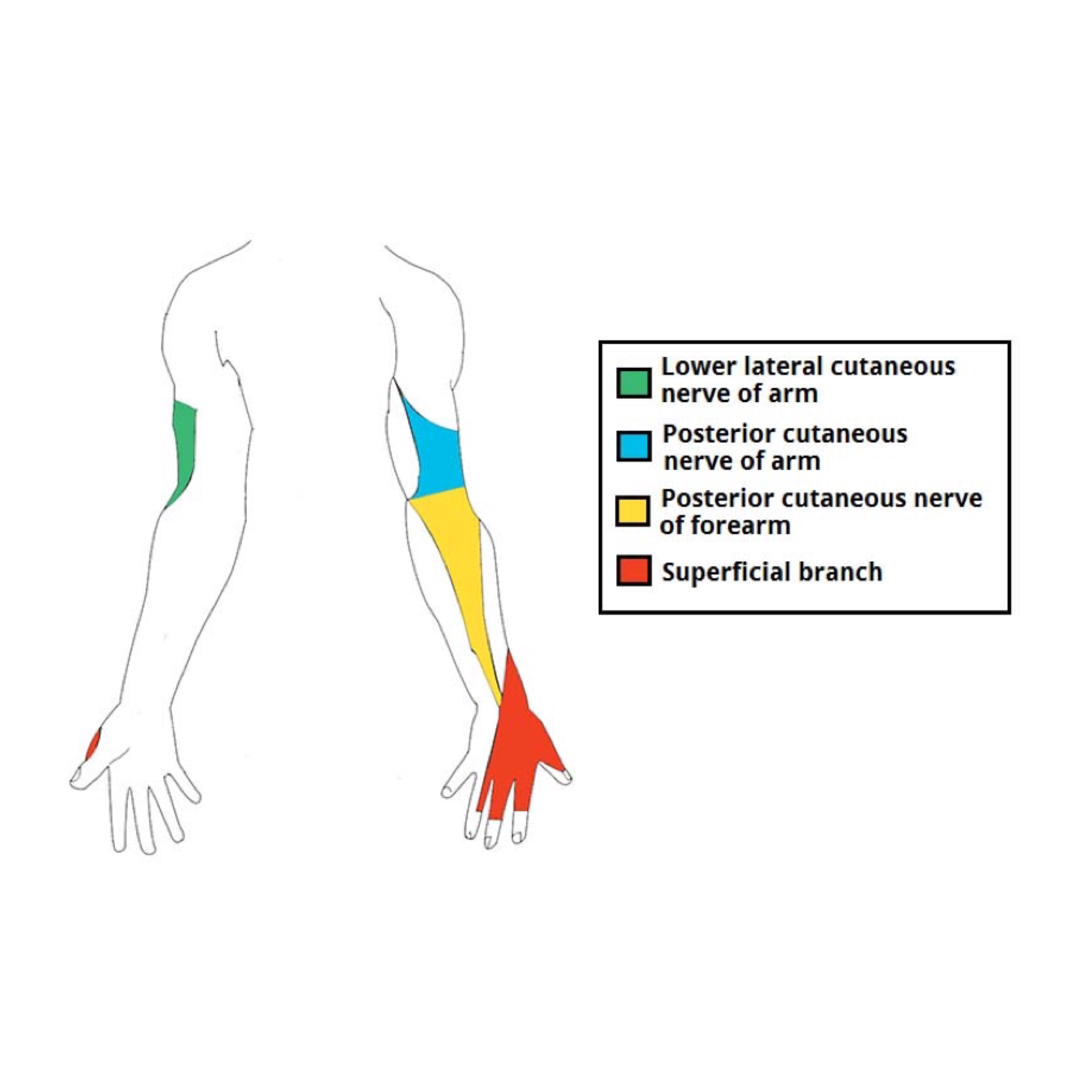
1)posterior cutaneous nerve of arm (posterior brachial cutaneous nerve). Which provide sensation to the posterior aspect of the arm.
2)lower lateral cutaneous nerve of arm (inferior lateral cutaneous nerve of arm). Which provide sensation to the lateral aspect of the arm below deltoid muscle insertion.
The motor nerve branches go to:
1) triceps brachii muscle.
2)anconeus muscle.
3)brachioradialis muscle.
While the sensory nerves are:
1)posterior cutaneous nerve of arm (posterior brachial cutaneous nerve). Which provide sensation to the posterior aspect of the arm.
2)lower lateral cutaneous nerve of arm (inferior lateral cutaneous nerve of arm). Which provide sensation to the lateral aspect of the arm below deltoid muscle insertion.

Upon interring cubital fossa and before it’s last termination it gives another sensory nerve branch called posterior cutaneous nerve of forearm (also called "posterior antebrachial cutaneous nerve”) which provide sensation to a strip of skin down the middle of the posterior forearm.
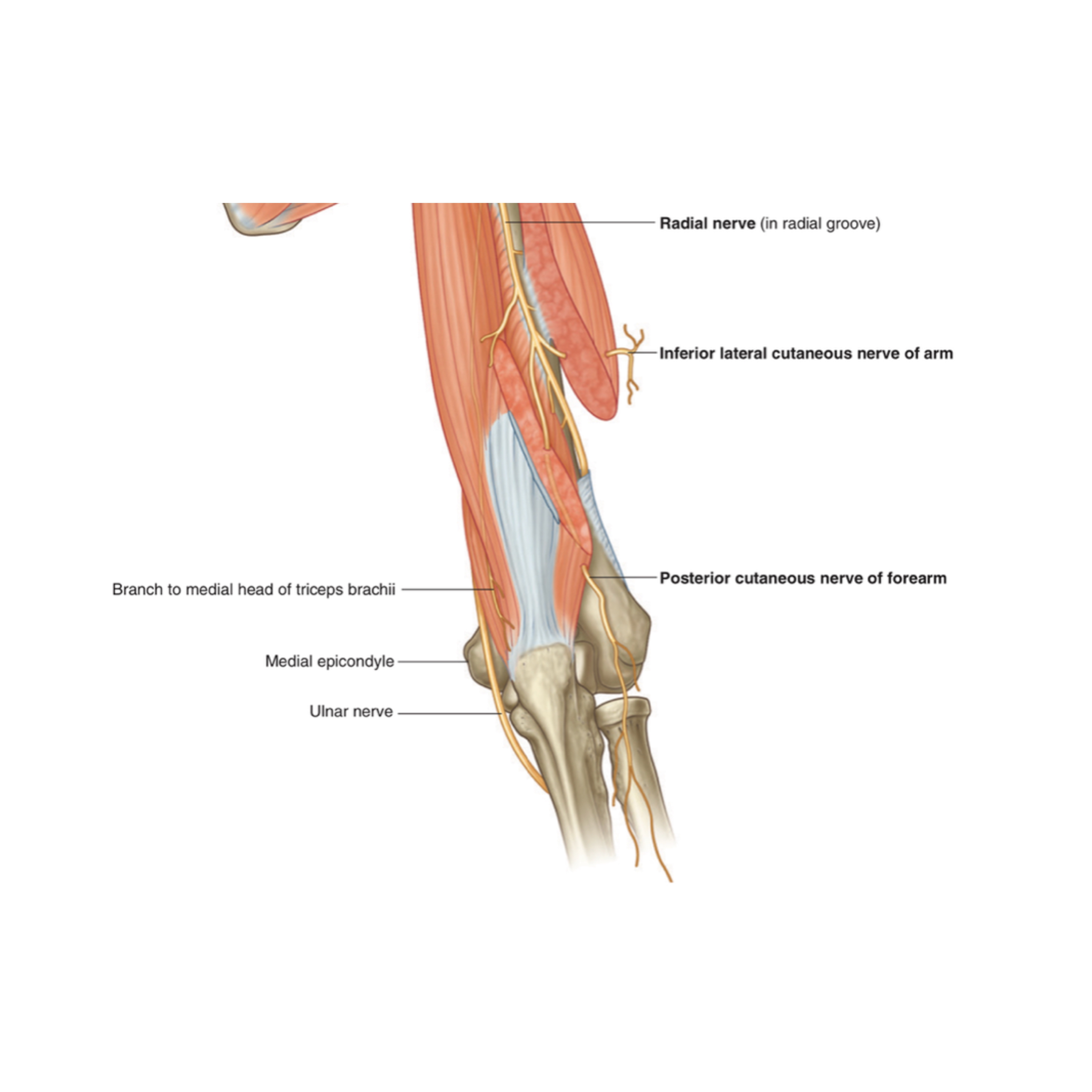
Then the radial nerve divide into deep and superficial nerve branches as we mentioned earlier.
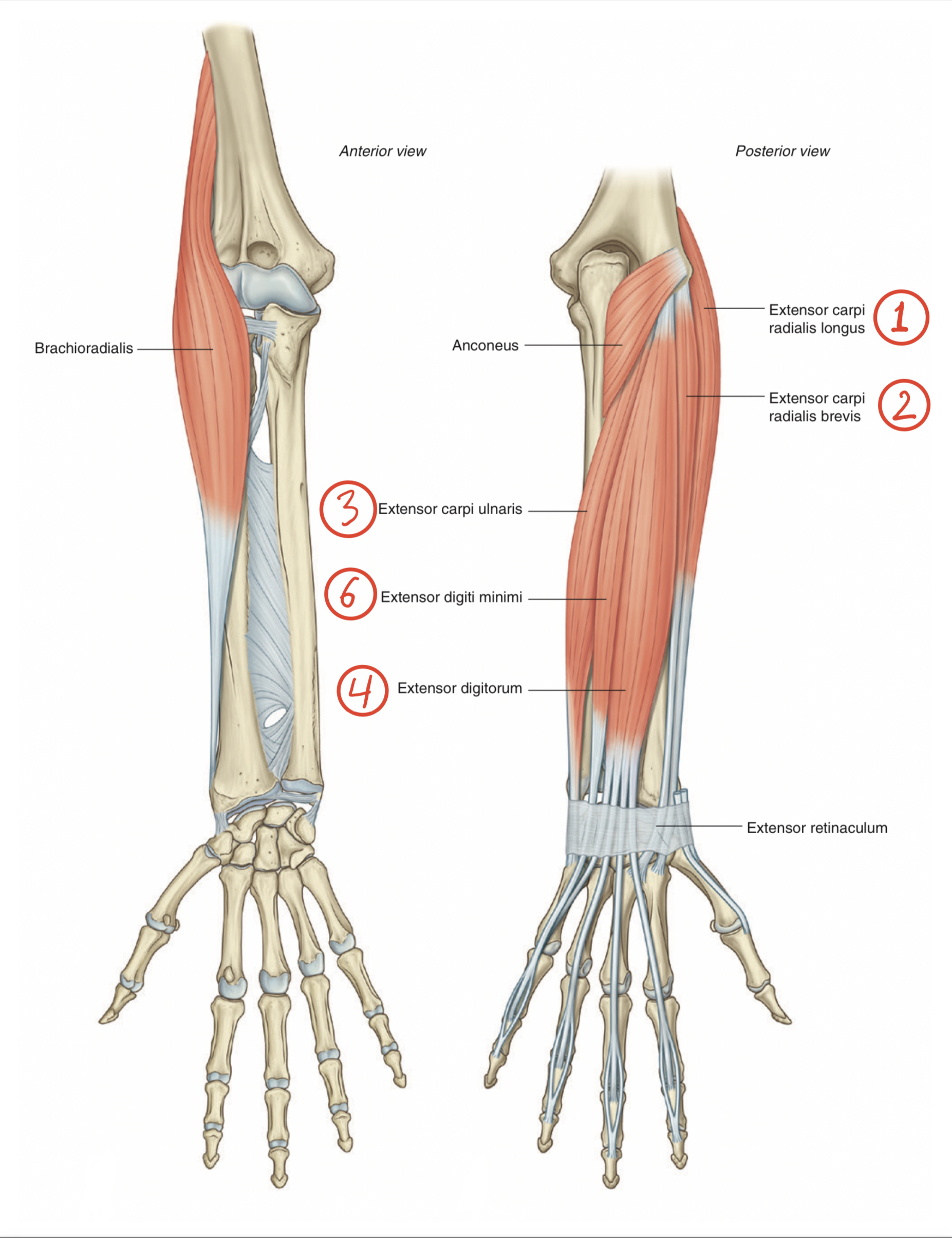
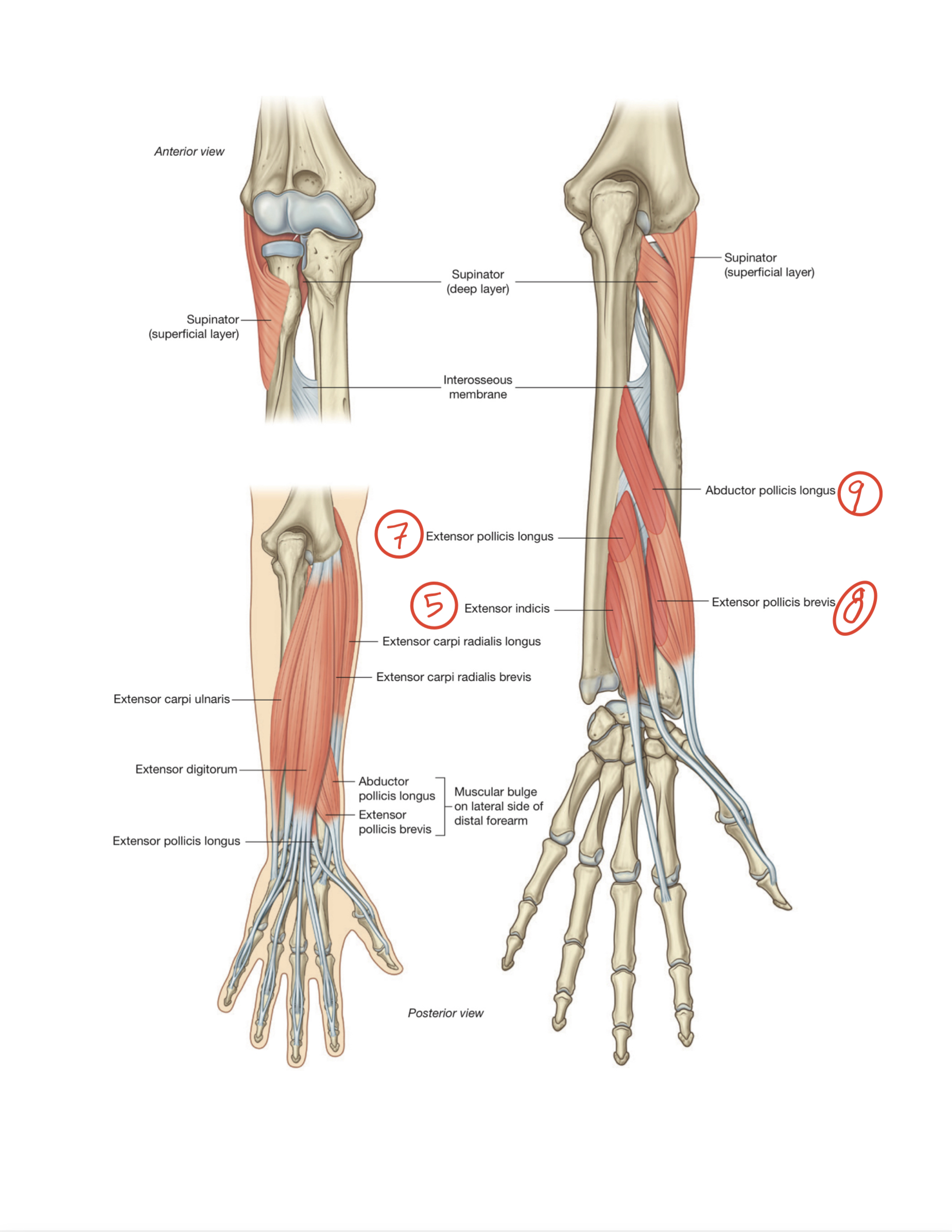
The deep branch (also known as the motor branch) provides the motor innervations to the muscles of posterior compartment of forearm and the long muscles of the thumb, this nerve descends inferiorly through the posterior aspect of the forearm where it passes between the superficial and deep layers of the supinator muscle and emerges as the posterior interosseous nerve.
It gives branches to:
1)extensor carpi radialis longus.
2)extensor carpi radialis brevis.
3)extensor carpi ulnaris.
4)extensor digitorum.
5)extensor indicis.
6)extensor digiti minimi.
7)extensor pollicis longus.
8)extensor pollicis brevis.
9)abductor pollicis longus.
The deep branch (also known as the motor branch) provides the motor innervations to the muscles of posterior compartment of forearm and the long muscles of the thumb, this nerve descends inferiorly through the posterior aspect of the forearm where it passes between the superficial and deep layers of the supinator muscle and emerges as the posterior interosseous nerve.
It gives branches to:
1)extensor carpi radialis longus.
2)extensor carpi radialis brevis.
3)extensor carpi ulnaris.
4)extensor digitorum.
5)extensor indicis.
6)extensor digiti minimi.
7)extensor pollicis longus.
8)extensor pollicis brevis.
9)abductor pollicis longus.
While the superficial (sensory) It passes down the anterolateral aspect of the forearm deep to the brachioradialis muscle and in association with the radial artery. Approximately two-thirds of the forearm, the superficial branch of the radial nerve passes laterally and posteriorly around the radial side of the forearm deep to the tendon of the brachioradialis muscle. The nerve continues to inter hand over snuffbox where it innervates skin over the dorsolateral aspect of the palm and the dorsal aspects of the lateral three and one-half digits distally to the terminal interphalangeal joints.

Clinical notes
Radial nerve palsy (also called “ radial neuropathy ”)
Radial nerve is the most injured nerve of the arm. The injuries of the radial nerve are usually due to fractures of the humerus. over using the nerve can also cause its damage (e.g., sports-related injuries) or compressed (e.g., improper use of crutches).
The Radial nerve injuries have distinct symptoms, depending on the anatomical location and type of injury.
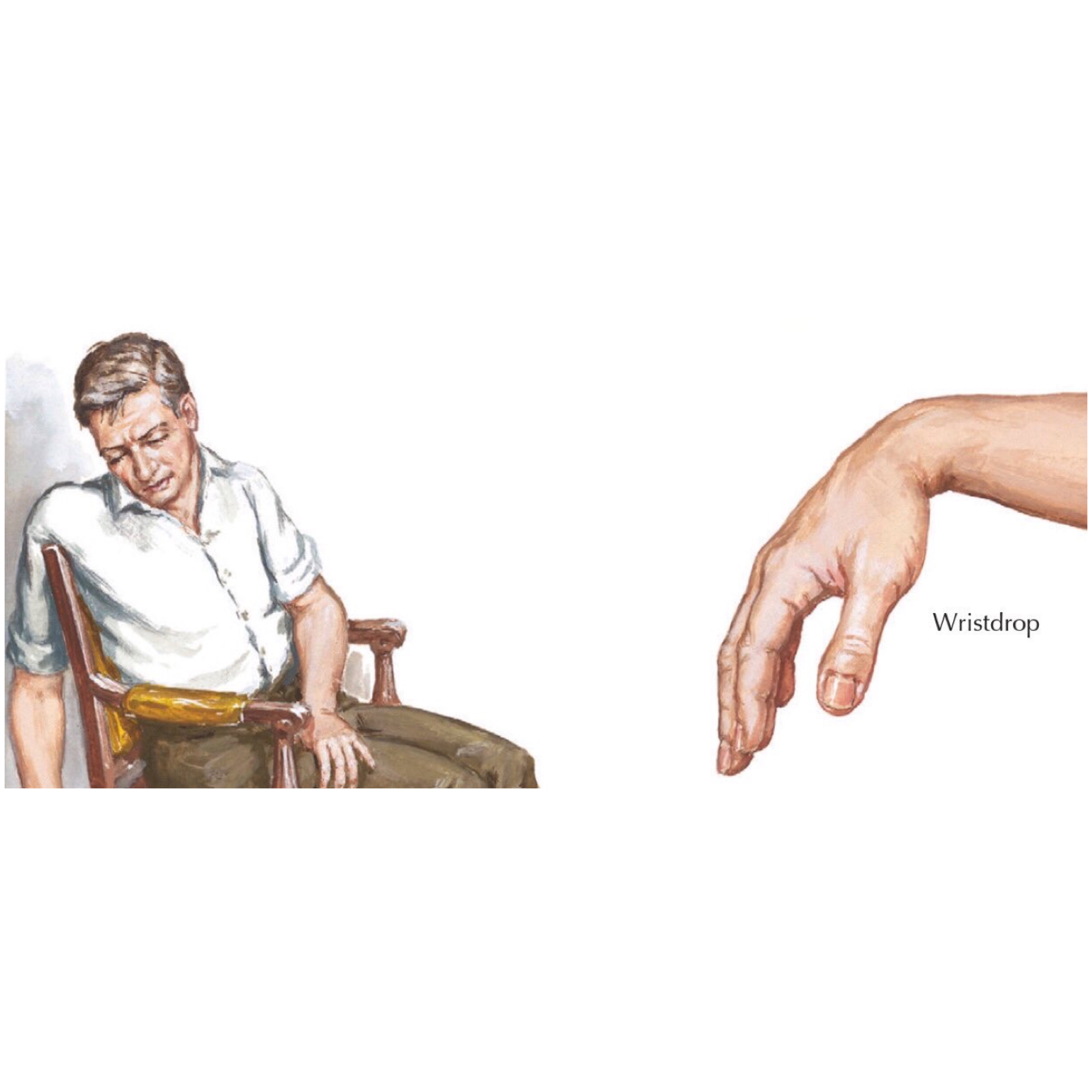
The most common motor presentation of the radial nerve injury is the "wrist drop". It occurs due to the paralysis of the muscles in the posterior aspect of forearm and their inability to extend the wrist.
While the sensory loss will depend on the anatomical location of the injury.
like: if the nerve is injured in the axillary region, there will be loss of sensation at the lateral arm and the posterior aspect of the forearm extending to the radial aspect of the hand and digits. This happens due to direct pressure onto the upper medial arm or axilla by an object or surface like with "Saturday night palsy" (when the arm is resting on the chair for a long time compressing the nerve).
Radial nerve is the most injured nerve of the arm. The injuries of the radial nerve are usually due to fractures of the humerus. over using the nerve can also cause its damage (e.g., sports-related injuries) or compressed (e.g., improper use of crutches).
The Radial nerve injuries have distinct symptoms, depending on the anatomical location and type of injury.
The most common motor presentation of the radial nerve injury is the "wrist drop". It occurs due to the paralysis of the muscles in the posterior aspect of forearm and their inability to extend the wrist.
While the sensory loss will depend on the anatomical location of the injury.
like: if the nerve is injured in the axillary region, there will be loss of sensation at the lateral arm and the posterior aspect of the forearm extending to the radial aspect of the hand and digits. This happens due to direct pressure onto the upper medial arm or axilla by an object or surface like with "Saturday night palsy" (when the arm is resting on the chair for a long time compressing the nerve).
References
1. Radial Nerve Injury; Alin Gragossian; Matthew Varacallo.; National Library of Medicine;
2. Radial nerve; Roberto Grujičić ,MD;Kenhub;
3. The Radial Nerve; Oliver Jones; teachmeanatomy;
4. Keith L. Moore , Arthur F. Dalley A. M. R. Agur; Moore clinically oriented anatomy 7thedition;pp.685,695,717,731
5. Dr. Lawrence E. Wineski,PhD;SNELLIS CLINICAL ANATOMY BY REGIONS 10th edition;ch3;pp.210,271,278,293,332,339,344,349-351
2. Radial nerve; Roberto Grujičić ,MD;Kenhub;
3. The Radial Nerve; Oliver Jones; teachmeanatomy;
4. Keith L. Moore , Arthur F. Dalley A. M. R. Agur; Moore clinically oriented anatomy 7thedition;pp.685,695,717,731
5. Dr. Lawrence E. Wineski,PhD;SNELLIS CLINICAL ANATOMY BY REGIONS 10th edition;ch3;pp.210,271,278,293,332,339,344,349-351